
If your website gets many visitors but no sales, it can be frustrating. There are several reasons for this. One common reason is a high bounce rate. This means visitors leave your site quickly, often in under 3 seconds, without interacting with your content. This may happen due to a poorly designed website or a lack of trust in your online store. To increase conversions, you should improve your landing pages and product pages, offering an excellent user experience and clear calls to action. Google Analytics can help you see the quality of your traffic and find the gaps between visitors and conversions. By fixing these issues, you can increase your conversion rate and turn visitors into customers.
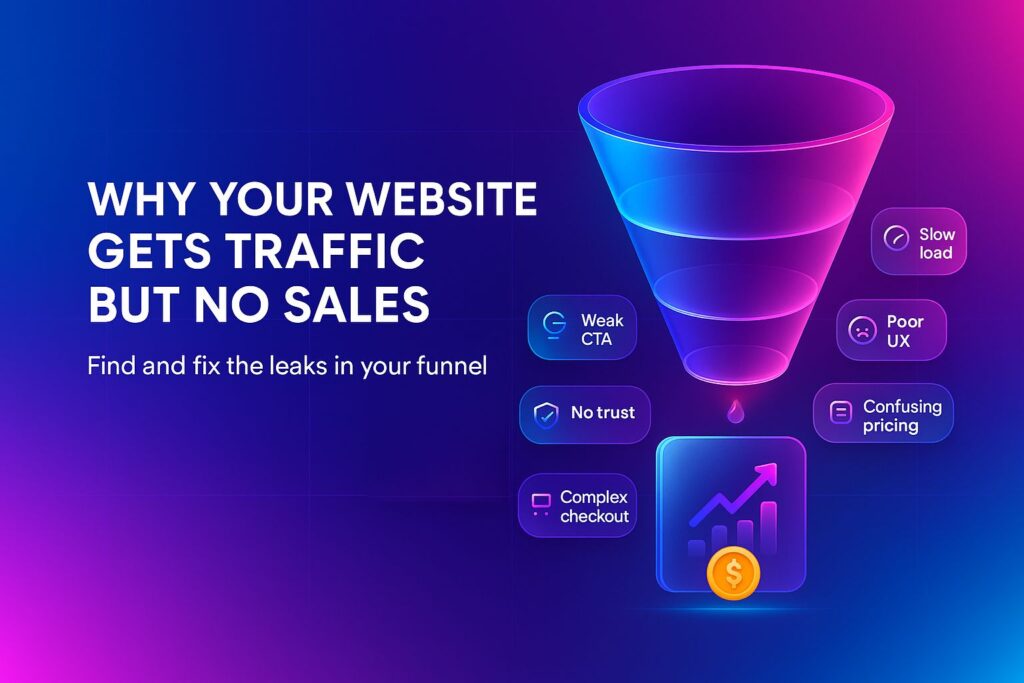
When visitors land on your website, their first question is often, ‘Can I trust this site?’ If your website gets a lot of visitors but no sales, it can be frustrating. There are a few reasons for this. One common reason is a high bounce rate, which means visitors leave your site quickly, often in under 3 seconds, without interacting with your content. This may happen due to a poorly designed website or a lack of trust in your online store. To increase conversions, you should improve your landing page and product pages, making sure they offer a good user experience and clear calls to action. Google Analytics can help you see the quality of your atraffic and find gaps between visitors and conversions. By fixing these issues, you can boost your conversion rate and turn visitors into customers.
One of the most common issues for a high bounce rate is slow website loading time. This gap between traffic and conversions can often be attributed to a low-quality user experience or ineffective calls to action on your landing page. Additionally, if your website isn’t optimized for mobile devices, you might be losing potential customers who access your business through their smartphones. It’s crucial to build trust with your audience, as high traffic but low conversions can stem from a lack of perceived security during the checkout process. To increase sales, focus on optimizing your website design, ensuring your product page is compelling.
A website not functioning well on mobile devices, leading to issues like slow loading times, difficult-to-read text, small buttons, and frustrating navigation, is called Poor Mobile Optimization. These issues create a frustrating user experience, particularly for visitors accessing your site via smartphones. Even with high traffic, poor mobile optimization can lead to low conversions as users abandon their carts or leave the site without engaging further. To address this, focus on improving your site’s mobile performance, ensuring fast loading times, clear text, and an intuitive, secure checkout process to boost conversions.
Confusing navigation can be a reason why your website gets traffic but no conversions. It occurs when visitors struggle to find what they need due to poor website design, leading to a high bounce rate. If users can’t easily navigate your site or locate key information, they are more likely to leave without engaging further, harming your conversion rate. To address this, optimize your website layout with clear menus, intuitive designs, and prominent call-to-action buttons. User-friendly experience builds trust and encourages visitors to stay, increasing conversion likelihood. Google Analytics can help identify navigation issues and guide improvements to turn traffic into sales.
Technical glitches, such as slow loading times or website bugs, can disrupt the user experience and lead to high bounce rates. Even with significant traffic from organic or paid sources, these issues can prevent visitors from buying. A smooth and efficient checkout process is essential for conversions. To address this, optimize your website for performance, particularly on mobile devices, and use Google Analytics to identify and resolve technical problems. Improving site functionality ensures a better user experience, increasing the likelihood of turning traffic into sales.
Too many pop-ups can disrupt the user experience and contribute to low conversions. While pop-ups can be effective for capturing leads or promoting offers, an excessive number can frustrate visitors and drive them away. This is especially true if pop-ups interfere with navigation or appear at inconvenient times, such as during the checkout process. To improve conversions, ensure that pop-ups are strategically placed, non-intrusive, and add value to the user experience. Simplifying the user journey and focusing on a seamless design can help build trust and encourage visitors to complete their purchases.
One of the key reasons why your website gets traffic but no conversions is trust and security issues. When users land on your site, they need to feel confident in their decision to engage with your product or service. If your website doesn’t have visible security features, such as SSL certificates or trust badges, potential customers may abandon their checkout process, leading to a high bounce rate. This lack of trust can especially impact e-commerce stores where financial transactions are involved. To convert high traffic into sales, it’s crucial to build a website that prioritizes the user experience and clearly communicates security measures. By optimizing your site for trust, you can significantly increase conversions and reduce abandonment rates, transforming clicks into loyal customers.
A lack of trust signals is a key reason why websites with high traffic fail to convert visitors into customers. Trust signals, such as visible security badges, clear privacy policies, and customer testimonials, reassure visitors that their information is safe and that your business is credible. Without these elements, potential customers may feel hesitant to complete a purchase, leading to abandoned carts and a high bounce rate. To increase conversions, prioritize building trust through quality content, secure checkout processes, and visible proof of customer satisfaction.
A lack of trust signals, such as missing or unclear contact information, can significantly impact conversions. Visitors need reassurance that your business is legitimate and accessible before making a purchase, especially in e-commerce. If your website lacks visible contact details, such as phone numbers, email addresses, or a physical address, it can create doubt and lead to abandoned carts. To build trust and improve conversions, ensure your contact information is prominently displayed and easy to find. This transparency helps visitors feel secure, reducing hesitation during the checkout process.
Inconsistent branding can undermine trust and lead to lower conversions. When visitors encounter conflicting design elements, messaging, or visual styles across your website, it creates confusion and raises doubts about your business’s credibility. A cohesive and professional brand identity, including consistent logos, colors, and tone, helps build trust and reinforces your brand’s reliability. To improve conversions, ensure that your website reflects a unified brand image across all pages, making it easier for visitors to feel confident in their decision to purchase.
One of the key reasons your website gets traffic but no conversions lies in your audience targeting. While you may be getting high traffic from sources like Facebook ads, if the users arriving at your site are not genuinely interested in your product or service, this can lead to a high bounce rate and lower sales. Engagement on your landing page is crucial; if it doesn’t resonate with your target customer, it may result in clicks but no conversions. To bridge the gap between traffic and conversions, it’s essential to optimize your site for relevant traffic that aligns with your sales strategy. This can involve enhancing the user experience on your product pages and ensuring a smooth checkout process. This will boost conversions and increase sales.
Irrelevant traffic occurs when the visitors coming to your website are not part of your target audience or do not have a genuine interest in your products or services. This often results in high traffic but low conversions, as these visitors are unlikely to engage or make a purchase. To address this, focus on refining your marketing strategies, such as using targeted keywords, optimizing ad campaigns, and improving SEO to attract qualified traffic. Analyzing your audience and ensuring your content aligns with their needs can significantly improve conversion rates.
Using the wrong keywords can attract visitors who are not genuinely interested in your products or services, leading to high traffic but low conversions. This mismatch between user intent and your offerings results in a high bounce rate and wasted marketing efforts. To fix this, conduct thorough keyword research to identify terms that align with your target audience’s needs and intent. Optimize your content and ad campaigns with relevant keywords to attract qualified traffic, ensuring that visitors are more likely to engage and convert.
Before optimizing your website, it’s crucial to analyze its performance to identify areas that need improvement. Without understanding how users interact with your site, any changes you make may not effectively address the issues causing low conversions. Use tools like Google Analytics to track user behavior, such as bounce rates, time on page, and cart abandonment. This data will help you pinpoint problem areas, such as confusing navigation or a lack of trust signals, and guide your optimization efforts to enhance the user experience and boost conversions.
To convert traffic into sales, it’s crucial to enhance your website’s user experience and design. A well-optimized landing page can significantly impact your conversion rate. If you’re getting high traffic but low conversions, consider factors like page load speed and a streamlined checkout process. High bounce rates indicate that visitors may not trust your site or find the experience lacking. Utilize Google Analytics to analyze user behavior and identify gaps. By focusing on improving your product pages and incorporating effective calls to action, you can build trust and ultimately increase conversions. This will ensure that your website doesn’t just get clicks but also drives sales.
Optimizing your website for speed and mobile devices is essential for improving user experience and increasing conversions. A slow-loading website or one that is not mobile-friendly can frustrate visitors, leading to higher bounce rates and lower engagement. Many users access websites on their mobile devices, so ensuring your site is responsive and loads quickly on all screen sizes is crucial. By improving site speed and mobile optimization, you create a seamless browsing experience, which helps build trust, reduce cart abandonment, and ultimately boost conversions.
To boost conversions on your website, strengthen calls-to-action (CTAs). When you’re getting high traffic but low conversions. A strong CTA can bridge the gap between traffic and conversions by guiding customers towards the next step. Ensure your CTAs are clear, persuasive, and strategically placed on your landing and product pages. Engaging CTAs can significantly increase sales and improve the overall user experience, converting visitors into loyal customers.
Building trust with your audience is crucial for converting website traffic into sales. When visitors feel secure and confident in your business, they are more likely to complete a purchase. One way to build trust is by providing clear and accessible contact information, such as phone numbers and email addresses. This reassures customers that they can easily reach out if they have questions or concerns. Additionally, displaying trust signals like secure payment options, customer reviews, and a professional website design can further enhance credibility. By focusing on trust-building elements, you can reduce cart abandonment and improve overall conversions.
To increase conversions, align SEO strategies with user intent. When your website gets traffic but no conversions, it often indicates a gap between what users expect and what your site offers. Focus on creating a seamless user experience that builds trust, particularly on key pages like your product page and landing page. A high bounce rate may signal that your content doesn’t resonate with visitors, leading to clicks but no conversions. By optimizing your website design and ensuring it addresses customer needs, you can transform organic traffic into sales, ultimately boosting your conversion rate.
To increase conversions, align SEO strategies with user intent. When your website gets traffic but no conversions, it often indicates a gap between what users expect and what your site offers. Focus on creating a seamless user experience that builds trust, particularly on key pages like your product page and landing page. A high bounce rate may signal that your content doesn’t resonate with visitors, leading to clicks but no conversions. By optimizing your website design and ensuring it addresses customer needs, you can transform organic traffic into sales, ultimately boosting your conversion rate.
Solving low conversion rates on your website involves addressing key factors that influence user trust and engagement. One critical aspect is ensuring that your contact information is easily accessible. When visitors can’t find clear ways to get in touch or feel uncertain about the business, they are more likely to abandon their carts and leave the site. This lack of trust contributes to a high bounce rate and low conversions. To improve conversions, make sure your contact details, such as phone numbers and email addresses, are prominently displayed. Additionally, using tools like Google Analytics can help you monitor user behavior and identify areas for optimization. By building trust and enhancing the user experience, you can reduce cart abandonment and increase the likelihood of turning visitors into customers.
One of the primary reasons why your website gets traffic but no conversions is the quality of that traffic. If you’re getting clicks but no conversions, it may indicate that users visiting your site are not genuinely interested in your product or service. To increase conversions, focus on optimizing your SEO strategies to attract relevant traffic that aligns with your offerings. Analyze your Google Analytics to identify the type of traffic your website receives and ensure it matches your target audience.
Tackling low engagement with Conversion Rate Optimization (CRO) involves identifying and addressing the barriers that prevent visitors from taking desired actions on your website, such as making a purchase or filling out a form. One effective strategy is to ensure that your contact information is easily accessible. When users feel they can easily reach out to your business, it builds trust and reduces the likelihood of cart abandonment. By using tools like Google Analytics, you can monitor user behavior and identify areas where engagement is dropping off. This data can guide your CRO efforts, helping you optimize the user experience, streamline the checkout process, and implement trust-building elements like customer reviews or security badges. These improvements can significantly boost engagement and increase conversion rates.
In summary, understanding why your website receives traffic but fails to convert visitors into customers is crucial to improving your online presence. By analyzing user behavior, optimizing your website’s design and content, and ensuring a seamless user experience, you can address the underlying issues. This will enhance your conversion rates.
Increasing your capacity to handle more customers, sales, or traffic while maintaining efficiency and quality. To scale successfully, it’s crucial to have a solid foundation, including a well-optimized website with clear contact information, strong trust signals, and a seamless user experience. By addressing issues such as low conversions and cart abandonment, you can ensure that your business is ready to handle increased demand. Utilizing tools like Google Analytics to monitor engagement and optimize your site will help you identify areas for improvement and ensure that your infrastructure can support growth as you scale.
Have questions or looking to grow your business? Email us. The BizzAcquire team is ready to help with strategy, marketing, or development, whatever you need to take your brand to the next level.