AI Content SEO: A Practical Guide to Rankings & Leads
15 min read


AI Content SEO: How to Create Content That Earns Visibility, Trust, and Leads
AI can produce a polished article before your next meeting starts. That does not mean the article answers a worthwhile question, contains reliable information, or gives a potential customer a reason to choose your business.
That gap is where AI content SEO succeeds or fails.
For marketing teams, the opportunity is substantial: faster research organization, stronger briefs, easier editing, and more efficient content maintenance. But publishing becomes expensive when speed creates a backlog of shallow pages that someone must eventually verify, rewrite, or remove.
The practical goal is to use AI to support useful content, then connect that content to search visibility and business results. Here is how to build a workflow that does both.
What Is AI Content SEO?
AI content SEO is the practice of using artificial intelligence to support content research, planning, drafting, optimization, and maintenance while applying sound SEO principles. Its purpose is to help people find accurate, useful answers and move toward relevant business actions. Human judgment remains essential for evidence, originality, positioning, and publication decisions.
The term covers several different activities:
-
Organizing customer questions into topic groups.
-
Turning expert notes into an article outline.
-
Drafting explanations from approved source material.
-
Reviewing titles, headings, and internal-link opportunities.
-
Finding gaps in existing content.
-
Updating pages when products or customer needs change.
There is also a separate challenge: making content useful as a source for AI-generated answers. That overlaps with traditional SEO, but using AI to write a page and having that page cited by an AI system are different outcomes.
A good strategy addresses both without assuming that one automatically produces the other.
Can AI-Generated Content Rank on Google?
AI-generated content can appear in Google Search, but using AI does not establish quality or guarantee rankings. Google's guidance recognizes useful applications of generative AI while warning that producing many pages without adding user value may violate its scaled content abuse policy. Accuracy, relevance, and editorial review remain essential.
Google's guidance on generative AI content provides a useful starting point: evaluate the finished work and the value it delivers.
Consider two hypothetical software articles.
The first repeats common claims about productivity, lists features without verification, and recommends tools the writer has never evaluated.
The second explains a specific workflow, compares documented limitations, includes an original implementation checklist, and makes its assumptions clear.
Both might involve AI. Only the second gives a reader concrete help.
Should You Focus on Passing AI Detection Tests?
An AI detector score cannot establish whether an article is accurate, useful, or commercially relevant. Editing solely to change that score can distract a team from the weaknesses readers actually notice.
Review the content itself:
-
Are the examples specific?
-
Can important claims be checked?
-
Does the page explain meaningful tradeoffs?
-
Does the writing sound like your business?
-
Would someone leave knowing what to do next?
A human editor should improve the substance alongside the prose. Replacing a few predictable phrases will not rescue an article with nothing useful to say.
How Do You Choose the Right Keywords and Search Intent?
Choose keywords by identifying the questions your customers ask, the decisions behind those questions, and the page format that would help them. Review current search results, your existing search data, and sales conversations. Prioritize topics where your business can contribute useful evidence and offer a relevant next step.
“AI content SEO” can reflect several needs. A reader may want to understand Google's position, build a writing workflow, compare tools, or investigate why existing articles underperform.
One page cannot satisfy every possible need equally well.
What Should You Check Before Creating a Brief?
Start with five questions:
-
Who is searching? A founder, content manager, and technical SEO specialist need different levels of detail.
-
What are they trying to accomplish? Learning a concept differs from selecting a provider.
-
Which formats appear in search results? Guides, product pages, comparisons, and tools suggest different expectations.
-
What can you add? Look for missing explanations, evidence, local context, or practical constraints.
-
What should happen after reading? Define a useful next action before drafting.
For a Bangladesh-based business, local context might include Bangla and English terminology, delivery coverage, payment preferences, or customer support expectations. Include those details when they change the answer.
BizzAcquire's marketing strategy and planning services connect audience research, positioning, and funnel design—the decisions that should guide topic selection before content production begins.
What Does a Reliable AI Content SEO Workflow Look Like?
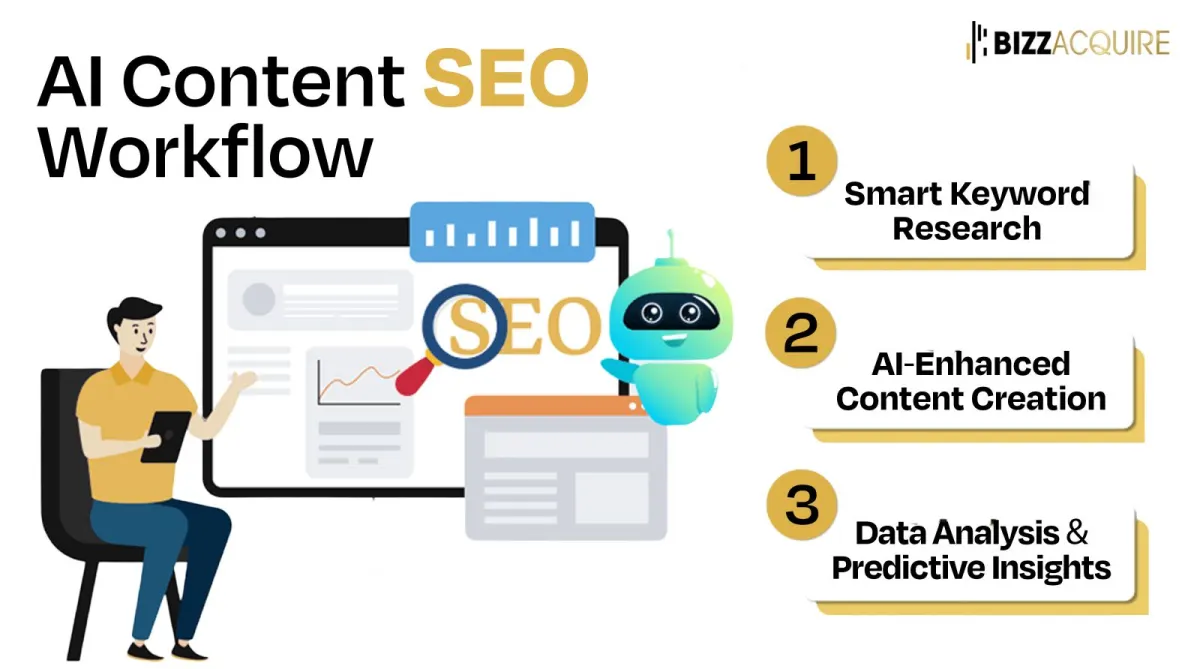
A reliable workflow moves from customer research to a clear brief, verified source material, assisted drafting, expert review, on-page optimization, and measurement. Each stage should have an owner and a completion standard. AI can accelerate individual tasks, but the person responsible for publishing must confirm that the finished page serves its purpose.
1. Build an Evidence Pack
Collect the material the article can safely use:
-
Approved product documentation.
-
Relevant primary sources.
-
Expert interview notes.
-
Customer questions.
-
Original screenshots or demonstrations.
-
Data with dates, definitions, and permission to publish.
Keep observations separate from assumptions. A customer's comment can illustrate a concern; it does not establish how an entire market behaves.
2. Write a Brief Before Requesting a Draft
Include the audience, primary question, supporting questions, business objective, source material, brand voice, and claims to avoid.
A useful instruction might be:
Draft a guide for small ecommerce teams evaluating AI-assisted product descriptions. Use only the supplied product facts. Explain where manual review is necessary, label hypothetical examples, and flag missing information instead of inventing it.
This gives the model a defined job and gives the editor a standard for review.
3. Draft in Manageable Sections
Review the outline first. Then draft sections where evidence and examples are already available.
This makes it easier to catch repetition, unsupported statements, and sudden changes in audience. It also prevents a weak initial assumption from spreading through an entire article.
4. Review Facts and Recommendations Separately
Check whether factual statements are correct. Then check whether the advice follows from them.
A feature may exist, but recommending it to every small business could still be poor advice. Budget, implementation effort, and team capability affect whether a recommendation makes sense.
5. Optimize After the Argument Works
Refine the title, introduction, headings, internal links, images, and call to action once the article answers its main question clearly.
BizzAcquire's SEO and content marketing services bring keyword research, technical work, editorial planning, and conversion optimization into the same marketing system.
 ## How Do You Add Original Value to AI-Assisted Content?
Add original value by contributing information readers cannot obtain from a generic summary: documented experience, direct demonstrations, expert explanations, customer evidence, or a decision tool. The contribution does not need to be expensive research. It needs to make the reader's understanding or decision materially better.
An article about AI product descriptions could include a worked example showing how an editor corrects a draft against an approved specification sheet.
An agency guide could explain which client inputs are required before work starts.
A software comparison could document a repeatable test using the same tasks and evaluation criteria across products.
What Can a Small Team Contribute Without a Research Budget?
Start with knowledge already inside the business.
Available material
Useful content contribution
Support questions
Troubleshooting explanations and FAQs
Sales objections
Decision guides and comparison criteria
Product demonstrations
Screenshots and step-by-step examples
Expert interviews
Attributed recommendations and tradeoffs
Delivery records
Clearly scoped operational observations
Customer feedback
Recurring concerns, with context and permission
For an illustrative sportswear example, “choose breathable fabric” offers little help. An explanation of fabric weight, stretch, washing instructions, and intended use gives customers a better basis for choosing.
Publish measurements only when you actually have them. Label constructed examples as examples. A confident voice comes from clear reasoning, not invented firsthand experience.
How Should You Optimize AI Content for SEO, AEO, and GEO?
Optimize AI-assisted content by making it relevant, accessible, well supported, and easy to understand. Answer important questions directly, explain limitations, and use descriptive headings and links. AEO and GEO provide useful perspectives on answer visibility, but Google's AI search features still rely on foundational SEO rather than a separate eligibility shortcut.
Answer engine optimization, or AEO, focuses on making answers easy to identify and understand. Generative engine optimization, or GEO, focuses on visibility within generative responses.
These labels describe goals; they do not establish guaranteed ranking methods.
How Should You Structure Answers?
Begin major sections with a concise answer, then provide the detail needed to apply it.
A useful pattern is:
-
Direct answer.
-
Explanation.
-
Evidence or worked example.
-
Exceptions and limitations.
-
Practical next step.
Use tables for comparisons and numbered lists for sequences. Write descriptive headings rather than clever labels that conceal the topic.
Keep sentences precise enough to make sense when quoted separately. “It works better” needs context. “An evidence-based brief gives editors a clearer standard for checking an AI draft” communicates a complete idea.
Do You Need Special Schema for AI Search?
Google's documentation on AI features says there is no special schema required for AI Overviews or AI Mode. Structured data should describe the visible page accurately. Eligibility does not guarantee inclusion.
For a blog post, BlogPosting markup can describe the headline, publisher, language, and subject. Add author details, publication dates, and images when those details are established and visible.
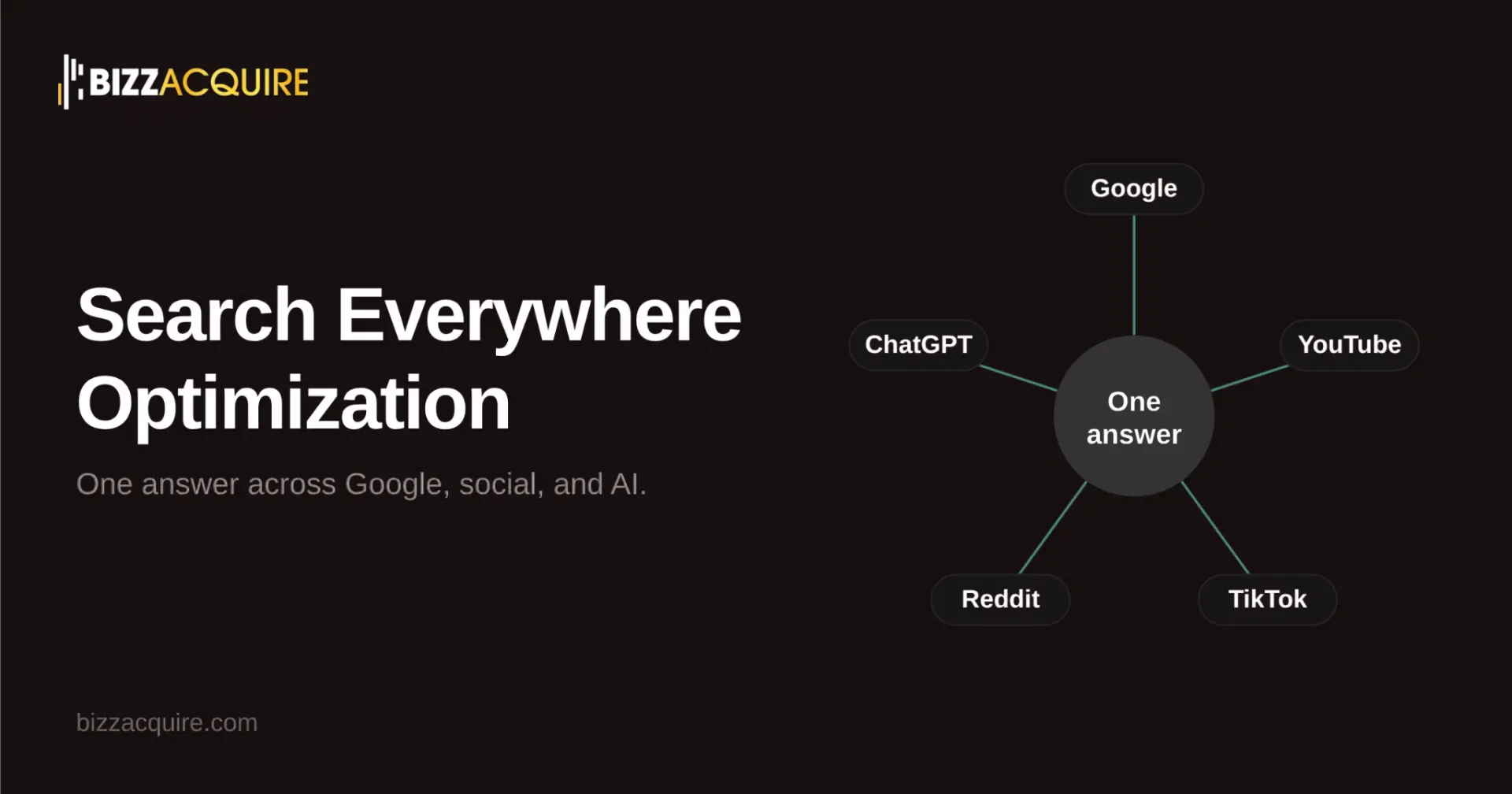
BizzAcquire's guide to Search Everywhere Optimization explores how one core answer can be adapted across website content, video, and social platforms.
Which AI Content Mistakes Create the Most Problems?
The most damaging mistakes are publishing unsupported claims, creating overlapping pages, copying competitors' substance, and measuring output instead of usefulness. These problems often begin before drafting, when teams choose topics without evidence or assign publication targets that exceed their review capacity. More content then increases maintenance work without solving additional customer problems.
Are You Publishing Several Pages for the Same Intent?
A keyword list can contain many variations of one underlying question.
Before creating separate articles, compare the intended reader, answer, and next action. If all three are substantially the same, one stronger page may be more useful.
A content map should record:
-
Primary intent.
-
Existing page.
-
Supporting topics.
-
Evidence available.
-
Appropriate internal links.
-
Update owner.
Are You Treating AI as a Source?
A generated answer is a starting point for investigation. Verify claims against the underlying documentation or evidence.
Pay particular attention to statistics, quotations, pricing, product capabilities, and statements about search policies. Check titles, descriptions, and schema too; errors can appear outside the article body.
Are You Adding FAQs Without Improving the Answer?
Include FAQs when they address useful questions the main article has not fully resolved.
Repeating the introduction in five variations creates length without helping the reader. Likewise, forcing the primary keyword into every heading makes navigation less natural.
A practical test: could you explain why each section belongs? If its only purpose is to increase word count, remove or replace it.
How Can You Turn Customer Experience Into Better SEO Content?
Customer experience research improves content by revealing where people hesitate, misunderstand an offer, or need reassurance. Support tickets, reviews, onboarding questions, and sales conversations provide concrete language for those problems. Use that evidence to improve explanations, comparisons, and next steps while protecting customer privacy and preserving the context of feedback.
Imagine an ecommerce team repeatedly receiving questions about whether a garment fits loosely or closely.
A broad fashion article may attract visitors but leave that concern unresolved. A detailed sizing explanation, measurement diagram, and accurate product-page guidance address the problem directly.
The same principle applies to services. If prospects repeatedly ask what happens after signing, publish an explanation of the onboarding process rather than another general article about your industry.
BizzAcquire's customer experience services cover journey mapping and feedback loops that can help businesses identify those moments of uncertainty.
How Do You Measure Whether AI Content SEO Is Working?
Measure AI content SEO through search visibility, relevant visits, meaningful actions, and production efficiency. Compare performance against a documented baseline and account for other changes affecting results. Publishing faster is useful only when the resulting content maintains quality and contributes to customer understanding, qualified demand, or revenue.
Use a balanced scorecard.
Area
What to track
What it helps you assess
Search visibility
Relevant impressions and query coverage
Whether pages reach intended searches
Visits
Organic landing-page traffic
Whether visibility produces visits
Conversion
Qualified enquiries, trials, or purchases
Whether content supports business goals
Sales quality
Accepted leads and resulting opportunities
Whether enquiries match your offer
Efficiency
Drafting time, editing time, and rework
Whether AI improves the full workflow
AI visibility
Sampled mentions and citations
Directional presence in answer engines
What Does Better Performance Look Like?
Consider a hypothetical comparison.
An article receives 1,000 visits and produces 10 qualified enquiries. Another receives 600 visits and produces 18.
The second page generates a 3% qualified-enquiry rate, compared with 1% for the first. That arithmetic does not prove greater profitability, but it shows why traffic alone cannot establish success.
Connect analytics events to CRM outcomes where possible. BizzAcquire's MarTech and tracking services cover the CMS, CRM, tracking, and integrations needed to make those connections more reliable.
Treat manual AI visibility checks as samples. Record the question, platform, date, and sources shown. A single favorable response is insufficient evidence of consistent visibility.
What Should Your First 30 Days Look Like?
Use the first month to test a manageable workflow on a small number of commercially relevant pages. Establish a baseline, gather evidence, publish reviewed improvements, and check that measurement works. The aim is to learn whether your process produces useful content consistently before increasing publication volume.
Week 1: Select and Audit
Choose one existing article and one new topic tied to a real customer decision.
Record current performance and identify missing answers, unsupported claims, and relevant service pages.
Week 2: Gather Evidence and Draft
Interview an expert, collect approved material, and prepare briefs. Use AI to organize and draft from those inputs.
Track editing time as well as drafting time.
Week 3: Review and Publish
Verify claims, improve examples, check links, and review mobile presentation. Confirm that calls to action and tracking work.
Week 4: Evaluate the Process
Look for early signals and workflow problems. Search outcomes may take longer to assess, so avoid declaring success or failure from a few days of data.
The immediate questions are practical: Was the page useful? Was review manageable? Can the team repeat the process?
If your team needs help connecting content production with research, SEO, and conversion measurement, contact BizzAcquire to discuss the gaps in your current workflow.
How Can BizzAcquire Create SEO Content That Helps Your Business Get Found?
BizzAcquire brings audience research, keyword targeting, content planning, and SEO together to create articles that answer your customers’ questions and support business growth. The focus is on choosing relevant opportunities, developing useful content, and connecting search visibility with qualified enquiries—not simply filling a publishing calendar.
How Does the Content Strategy Start With Your Business?
Effective content begins with understanding your offer, ideal customers, and the questions that delay a purchase. Those inputs help determine whether your business needs an educational guide, a service comparison, a product explanation, or an update to an existing page.
For example, a software company may benefit more from an article answering “How do I migrate customer data to a CRM?” than a broad introduction to digital transformation. The narrower question connects directly to a problem its potential customers need to solve.
How Do Keyword and Competitor Research Shape the Article?
A business-focused content plan should evaluate three things before writing:
-
Keyword potential: Search demand, commercial relevance, competition, and how well the topic fits your offer.
-
Search intent: Whether readers need an explanation, comparison, practical walkthrough, or service provider.
-
Competitor gaps: Questions competing pages leave unanswered, outdated information, weak examples, and missing decision criteria.
The strongest opportunity is not always the keyword with the highest volume. A specific query that attracts suitable buyers can deserve priority over a popular topic with little connection to your services.
What Makes the Finished Content Worth Reading?
Research should become a clear editorial brief, then an article with direct answers, useful examples, verified claims, and a consistent brand voice. Relevant internal links help readers explore related information, while a natural call to action connects the article to the next step.
AI can assist with organization and drafting. Human review should confirm the accuracy, relevance, and quality of the finished work.
How Does Content Improve After Publication?
Track relevant search queries, organic visits, qualified enquiries, and sales outcomes. Use those findings to strengthen explanations, address missing questions, and update pages as your business changes.
No agency can guarantee a specific ranking. A research-led approach gives your content a stronger foundation for earning visibility—and makes that visibility more useful to your business.
Want this kind of thinking applied to your marketing?
Book a free consultation and we will look at where your growth is actually stuck.