Search Everywhere Optimization: A Guide for Startups & SMEs
15 min read

Search Everywhere Optimization: How to Become the One Answer Buyers Find on Google, Social, and AI
Nobody wakes up wanting to search. People search because they're stuck between options and want to feel sure enough to choose one. Today that decision doesn't happen on a single platform. A buyer might spot you on TikTok, research you on Google, check what real people say on Reddit, and then ask ChatGPT which option to pick.
That changes what "winning at search" means. Ranking first in one place is no longer enough. You need to be the trusted answer everywhere your buyer looks. This guide explains how, in plain terms, for founders and marketing teams who don't have a giant team or budget.
What is Search Everywhere Optimization?
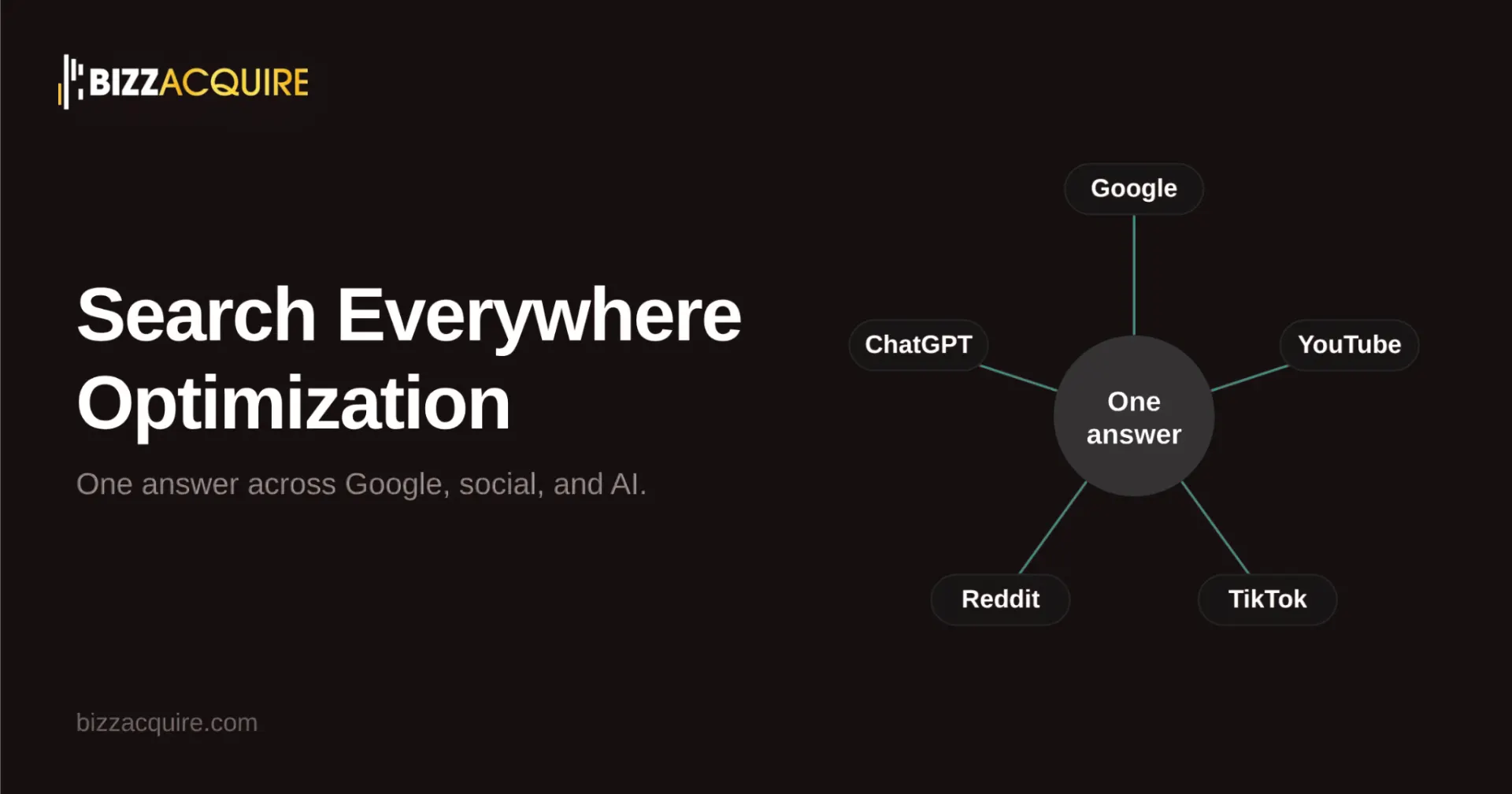
Search Everywhere Optimization (SEvO) is the practice of making your brand the clear, consistent answer on every platform where buyers ask questions: Google, YouTube, TikTok, Instagram, Reddit, and AI tools like ChatGPT. Instead of chasing one ranking, you build one core answer and adapt it to each surface.
The word "everywhere" scares people, and fairly so. It sounds like five platforms, five teams, and five sets of deadlines. That isn't what SEvO asks of you. The idea is closer to the opposite: fewer, deeper ideas, told in the format each platform prefers.
How is SEvO different from traditional SEO?
Traditional SEO focuses on ranking pages in Google. SEvO keeps those fundamentals but extends the goal to being found, trusted, and cited across social platforms, video, communities, and AI answer engines, using one consistent message.
Traditional SEOSearch Everywhere OptimizationMain goalRank pages on GoogleBe the trusted answer on every surfaceWhere it playsGoogle (and Bing)Google, YouTube, TikTok, Instagram, Reddit, AI toolsContent unitKeyword-targeted pageOne core answer, adapted per platformAuthority signalBacklinks, on-page relevanceRelevance, brand mentions, consistency, evidenceSuccess metricRankings, organic trafficVisibility, citations, and conversions across surfaces
Is SEO dead?
No. SEO is the foundation SEvO builds on. Google's own documentation says the existing SEO fundamentals still apply to its AI features. What died is the assumption that one search engine, and one results page, holds your whole audience.
Two mistakes show up again and again. Some brands treat "search" as a synonym for Google and pour everything into one channel. Others panic at an "SEO is dead" headline, walk away from Google, and go all-in on social. Both are picking a door. Your buyer stopped picking doors years ago.
If you're weighing SEO against paid channels as part of this picture, our breakdown of SEO vs PPC ROI shows why integrating both usually beats choosing one.
 ### Why are buyers searching in more places than Google?
Buyers now move between platforms within one decision. NP Digital's research found about one in five people search directly on social media, and when it surveyed where buyers discover brands, social came first, with AI tools like ChatGPT already at 16%.
Let's slow down on that 16%. AI as a discovery channel barely existed three years ago. Now it sits in the same conversation as the platforms that have been around for a decade or more. These figures come from NP Digital's own surveys, so treat them as directional rather than universal. But the pattern matches what most marketers see in their own analytics: discovery is scattered.
Here's a simple, illustrative scenario. Imagine a founder shopping for accounting software:
- She sees a short video on TikTok or Instagram comparing tools for small teams.
- She Googles two of the names to read reviews and pricing pages.
- She checks Reddit to see whether real users complain about the same thing.
- She asks ChatGPT, "Which is better for a five-person company?"
Your brand can be strong at step two and invisible at steps one, three, and four. She'll never know you existed. Or worse, she'll find a contradiction between what you say on one platform and what people say on another.
What's the right question to ask instead of "which channel wins"?
Ask "where does my buyer ask questions?" and map every place. That map is your strategy. Once you know the surfaces, you can decide how to cover them without multiplying your team.
This is a small mindset shift with big practical effects. A channel-first plan asks, "Should we be on TikTok?" A question-first plan asks, "What does our buyer type or say before choosing us, and where do they type it?" The second version usually reveals two or three surfaces that matter and a few that don't.
Is social media content now search content?
Yes. In July 2026, Google launched platform properties in Search Console, letting you connect Instagram, TikTok, X, and YouTube accounts and see the queries, impressions, and clicks your posts earn on Google. It's a reporting feature, not a ranking change, but it shows social posts appear in search results.
Google announced the feature on its Search Central Blog, describing how you can track which search terms lead people to your social and video content. Let's be precise about what this does and doesn't mean. It doesn't change how anything ranks. Google was already surfacing social content in search for a while. What changed is that Google now gives you the receipts.
And think about what that implies. Companies don't usually build measurement tools for things they consider noise. Your Reels and TikToks are, at least some of the time, search results.
How do you connect a social account to Search Console?
Open Search Console, add a new property, choose Instagram, TikTok, X, or YouTube, and follow the on-screen steps to authorize the connection through that platform's own login. Then give it a few days to start showing data.
Here's the short version:
- Sign in to Google Search Console.
- Choose "Add property" and select the platform.
- Authorize the connection through the platform's login flow.
- Wait for data to appear, then look at queries, impressions, and clicks per post.
- Note which posts already earn impressions and why.
Most of your competitors haven't looked at this yet. That gap is your opening.
What kind of social content actually shows up in Google?
Content shaped like an answer. Posts built purely for the scroll (trends, hooks, dances) may do well in-feed but rarely match a typed question. Posts that answer something specific, like "best accounting software for small teams" or "is this product worth it," are the ones that surface in search.
Nobody types "fun hook about our brand" into a search box. People type questions. So the practical move is to build social content around the questions your buyers really ask. If you're not sure what those are, a free tool like AnswerThePublic shows the questions people search around a topic, in their own words.
Every question is a post waiting to be made. A few examples of the shift:
- Instead of "Our new feature is here!" → "How do I track cash flow without a finance team?"
- Instead of a trending audio with product shots → "Is [product type] worth it? Here's what we'd check first."
- Instead of a generic brand reel → "What should a small business include on a product page?"
Our Speedy Sportswear SEO case study shows the same principle on the website side: product pages restructured with titles and descriptions that reflect real search intent, and a reported 180% traffic increase. Social works the same way. Match the question, and you get found.
How do you get recommended by AI search engines like ChatGPT?
AI engines usually pick a small number of sources and summarize them into a verdict, so being cited matters more than being ranked. NP Digital's analysis of 82 factors behind ChatGPT recommendations put content relevance first and brand mentions second, with backlinks near the bottom.
Think about how different that is from a results page. Ask "What's the best CRM for a home service business?" and you don't get ten blue links. You get one answer, maybe two. Everyone else in the category might as well not exist for that buyer.
The same thing is happening inside Google with AI Overviews and AI Mode, which read the options and hand back a conclusion.
Why does AI traffic matter if the volume is small?
Because it tends to arrive pre-sold. NP Digital reports that visitors referred by AI convert around eight times more than traditional traffic, likely because the AI has already compared, vetted, and recommended you before the click.
That's one company's measurement, so hold it lightly. But the logic holds up. Someone who asks an AI for a recommendation, then clicks through to the one it names, has already done most of their comparison shopping. Small traffic source, high intent.
What does AI actually reward?
Based on NP Digital's findings, three things matter most: content that fully answers a specific question, brand mentions on sites you don't own, and evidence such as real author names and original data. Volume doesn't help.
Let's break it down:
- Relevance comes first. The content that most completely answers the specific question wins. No surprise there.
- Brand mentions come second. How often you're talked about across the web, on sites you don't control. The AI isn't only reading your content. It's reading what the internet says about you.
- Backlinks scored near the bottom. NP Digital rated them 1.9 out of 5 for ChatGPT recommendations. Twenty years of link-building habits barely registering is a big deal for anyone whose whole SEO plan is links.
This kills the volume strategy. Flooding the internet with hundreds of shallow AI-written posts doesn't earn citations. One deep, evidence-backed piece with real author names, third-party mentions, and original data beats ten thin ones. That's a measured ranking reality, not a content velocity game.
Video counts too. The video behind this article notes that YouTube content gets cited in AI Overviews at a much higher rate than most formats, which means your video strategy and your AI strategy overlap more than you'd think.
Do you need special tactics for Google's AI Overviews?
Not according to Google. Its documentation states that AI Overviews and AI Mode have no additional requirements or special optimizations, and that existing SEO fundamentals still apply, including crawlable pages, helpful content, and good internal linking.
Google spells this out in its AI features and your website documentation. It also says you don't need special schema.org markup to appear in those features. Structured data is still worth adding for clarity and rich results, but don't expect it to be a magic switch. The honest summary: do great SEO, then make sure that same substance is available in the formats AI tools and social platforms prefer.
How do you check whether AI mentions your brand?
Ask the tools directly. Run the questions your buyers would ask in ChatGPT, Perplexity, and Gemini, and note whether you appear, how you're described, and which competitors show up. Dedicated trackers such as Ubersuggest now offer AI visibility monitoring too.
A simple routine works fine:
- List 10 to 15 buyer questions ("best [category] for [type of business]").
- Run each through two or three AI tools.
- Record whether you're mentioned, cited, or missing.
- Screenshot the results for a baseline.
- Repeat monthly.
Most people who do this for the first time don't love what they find. That's useful information, not a failure.
How do you build one answer for every surface?
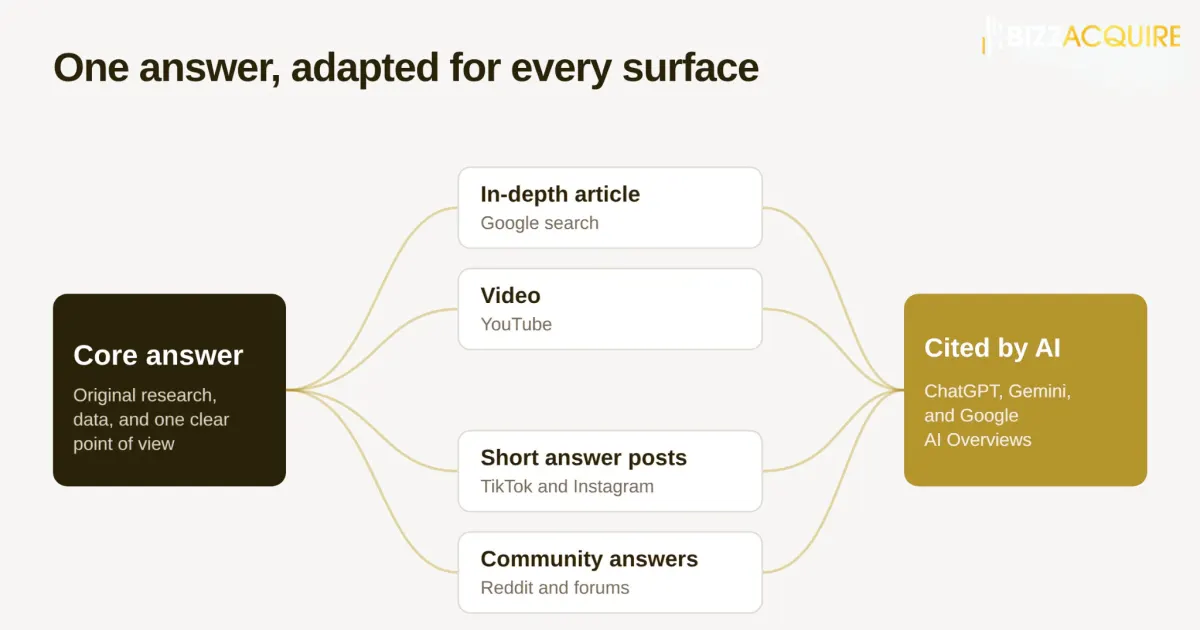
Create one deep core asset, one clear message, and one point of view you're known for, then translate it for each platform. The research becomes a blog post, the blog post becomes a video, the video becomes short answer posts, and the whole body of work becomes what AI tools cite.
This is the part that keeps SEvO from becoming triple the work. Think of it as one answer wearing four outfits.
StepAssetWhat it does1Original research or a strong point of viewGives you something citable and specific2In-depth article on your siteCaptures Google search and gives AI a source to quote3YouTube video based on the articleFeeds video search and AI citations4Three to five short question-led postsMatch social search behavior on TikTok and Instagram5Community participation (Reddit, forums)Builds the brand mentions AI tools weigh heavily
Notice what's missing: five different strategies. There's one idea. The format changes; the substance doesn't.
What does this look like for a small team?
Pick one recurring topic your buyers care about, spend most of your effort making the source asset genuinely excellent, and repurpose it in a set rhythm. A small team can do this without adding headcount if it resists starting five separate content streams.
If you're building your marketing around a broader plan, our guide to 360° marketing strategy covers how to align channels around shared goals and KPIs, which is exactly the coordination SEvO depends on.
Why does brand consistency matter more than ever?
AI systems and search engines effectively read everything about you as one picture: your site, socials, press, and reviews. When those surfaces contradict each other, you confuse customers and the systems deciding whether to recommend you, so inconsistent brands risk being skipped as a risk.
Here's how it goes wrong in practice. The TikTok voice is playful and cheap. The website is corporate and premium. The LinkedIn positioning targets enterprise, while the reviews come from freelancers. Each channel makes sense alone. Together they look like four different companies.
NP Digital's research on message consistency found that brands with one aligned message across surfaces convert meaningfully better than brands with fragmented messaging. So consistency isn't a branding nicety. It multiplies everything else.
A quick consistency check:
- Can you describe what you do in one sentence, and does every profile say roughly the same thing?
- Do your pricing, positioning, and claims match across your site, socials, and directories?
- Would a stranger who read your reviews recognize the company described on your homepage?
- Do you name the same categories, audiences, and differentiators everywhere?
If two answers are "not really," fix that before you publish anything new.
How can startups and SMEs put SEvO into practice?
Map where your buyers ask questions, build one deep core asset, adapt it into question-shaped posts and videos, and track results in Search Console and AI visibility checks. Most startups can start with a 30-day sprint and no extra headcount.
Here's a practical order of operations:
- Week 1: Map the questions. List what buyers ask before choosing you. Use customer calls, sales objections, support tickets, and question-research tools.
- Week 1: Audit consistency. Compare your website, social bios, reviews, and directory listings.
- Week 2: Build the core asset. One in-depth, specific piece with a clear point of view, real author names, and original data or examples from your own work.
- Week 3: Translate. Turn the asset into a video and several short question-led posts.
- Week 3: Connect measurement. Add platform properties in Search Console and run your baseline AI visibility check.
- Week 4: Review and adjust. Which posts earn impressions? Which questions do AI tools still answer without you?
Real results take longer than a month, of course. SEO and brand-building are compounding efforts. Think of the sprint as laying track, not crossing the finish line.
What mistakes should you avoid?
The biggest ones are spreading across too many platforms, publishing volume over depth, and letting messaging drift between channels. All three come from treating each platform as a separate project instead of one answer.
- Chasing every platform at once. Start where your buyers actually ask questions.
- Publishing lots of thin content. AI tools cite depth and evidence.
- Ignoring third-party mentions. If nobody else talks about you, you're missing a top signal.
- Writing for algorithms instead of people. Clear, specific, honest answers beat clever phrasing.
- Measuring only clicks. Impressions, citations, and brand searches all tell part of the story.
How do you measure whether it's working?
Track visibility and business outcomes together: Search Console impressions and clicks for your site and social properties, AI mentions across a fixed set of buyer questions, branded search volume, and conversions by source.
MetricWhere to find itWhat it tells youSite impressions and clicksSearch ConsoleGoogle visibility for your pagesSocial post impressions and queriesSearch Console platform propertiesWhich posts surface in GoogleAI mentions and citationsManual checks or an AI visibility trackerWhether tools recommend youBranded search trendSearch Console, Google TrendsGrowing brand awarenessConversions by sourceGA4 or your CRMWhich surfaces produce revenue
Tie all of it to business goals rather than vanity numbers. Our overview of results-driven digital marketing services in Bangladesh explains how we connect channel activity to ROI, CAC, and ROAS instead of stopping at clicks.
Where to start
Search didn't consolidate. It scattered. The brands that adapt fastest won't be the ones with the biggest teams. They'll be the ones who decide what they want to be known for, say it clearly, and show up the same way everywhere a buyer looks.
If you'd like a second pair of eyes on where your buyers search and whether you're the answer there, start with a free marketing audit from BizzAcquire. We'll show you the gaps and the next steps, without the fluff.
Frequently asked questions
What is Search Everywhere Optimization in simple terms?
It's making your brand the clear, consistent answer wherever buyers ask questions, including Google, YouTube, TikTok, Reddit, and AI tools. You build one core message and adapt it to each platform instead of running separate strategies.
Is Search Everywhere Optimization the same as GEO or AEO?
Not exactly. GEO and AEO focus on being cited by AI engines and answer features. SEvO is broader: it includes those, plus traditional search, social search, video, and community platforms, all tied together by one consistent message.
Do I need to be on every platform?
No. Start with the surfaces where your buyers actually ask questions. Mapping those places first keeps your effort focused, and you can add platforms later once the core asset and message are working.
How long does SEvO take to show results?
It varies. Quick signals, like social posts earning search impressions, can appear within weeks. Authority, citations, and brand mentions build more slowly, often over several months, as your body of work and third-party mentions grow.
Want this kind of thinking applied to your marketing?
Book a free consultation and we will look at where your growth is actually stuck.